Home

Choose a language:
Menu
Home
GMO
VersVoko's
Soy
Cook a planet
Amsterdam pages
About A SEED
Links
Search

Small thingies
A SEED infostall @ Ieperfest

From friday 13th till sunday 15th of August you can find A SEED on the festival with leaflets, brochures, dvd's books and T-shirts. Together with many other organisations like Anarchistisch Kollectief (be), Bite Back, Roots of Compassion, EDGE syndicate, Veg Nord, Vegan.fr,etc. You can also find us there for our latest action updates.

Read more...
 
A hot summer for climate action camps:
Tu 20. Jul. – We. 18. Aug.
Robin Wood-rafting "Floßtour - Klimaschutz selbst gemacht"

Th 22. Jul. – Su 1. Aug.
Climate Action Camp France / Le Havre, Normandy (F)

Mo 26. Jul. – So 1. Aug.
Climate Camp Swiss / Gals/Chules (BE)
Read more...
 
Support us
Want to save the world but too tired or busy to do it directly? Do you want to help finance campaigns against corporate criminals and their lobby groups? Then donate some money to A SEED Europe!
Read more...
 
Browser choice
It is best to visit this website with Firefox or another open source browser. The use of Micro$oft Internet Explorer is for your own risk and when you do, it is possible that the site will not look the way it is meant to do.

Image


Successful blockade of Monsanto in The Netherlands PDF Print
Thursday, 20 May 2010
ImageOn May 17 2010 about 40 persons of the action group 'Roundup Monsanto' blocked both gates of the Monsanto seed company in Bergschenhoek (near Rotterdam). 'Roundup Monsanto' wants Monsanto to back out of the seed market, and demand an end to patents on seeds and living organisms. Monsanto and other agro-chemical multinationals are lobbying the Dutch government and the EU for legislative changes that would make it easier for large companies to take control of the seed market and food production.[1] The blockade took place at the former De Ruiter Seeds, acquired by Monsanto in 2008, where research laboratories, offices, greenhouses, and a central storage for seeds and seedlings are to be found.

The two most important access doors to the Monsanto terrain have been closed off. The action group put up banners with the message "Imagine, monopoly of food, poisonous agriculture, The World according to ... Monsanto", adbusting the company's logo. It has also adjusted the giant cucumber and tomato on the lawn to Monsanto's manipulated reality. Employees and customers haven been greeted with coffee, tea, and background information on arrival.

Thierry Boyer, head of Monsanto's European vegetable division, contacted his superiors and decided not to press charges. As a result the police will not interfere. "The company will be effectively close for the day", the police chief in charge confirmed. Clearly Monsanto is afraid of more negative publicity connecting the company to a police eviction, and prefers to close down the plant where 350 people are employed. Many employees welcomed the action and said they were not happy with the take over of De Ruiter Seeds by Monsanto.

Image

The chemical company Monsanto has 23% of the worldwide market of commercial seeds  in its hands. In the last 5 years, the company has bought up three large internationally active seed companies in the Netherlands: besides De Ruiter Seeds as well Western Seeds, and Seminis. As a result, Monsanto now dominates the world market for vegetable seeds and seedlings. In addition, Monsanto is the market leader in genetically engineered soy, corn, sugar beets, and cotton, and has a large market share in pesticide sales. "Farmers and vegetable growers are becoming increasingly dependent on these big seed companies and patented seeds will make the situation even worse," says Flip Vonk, an organic farm employee present at the action.

Monsanto is a chemical company which has grown large due to the production of pesticides, Agent Orange, and PCBs. [2] After countless scandals revolving around these chemical substances, the company found a new market strategy: development and sales of genetically manipulated crops. These crops are cultivated in enormous monocultures, with excessive use of fertiliser and pesticides. Monsanto represents a destructive model of chemical agriculture.

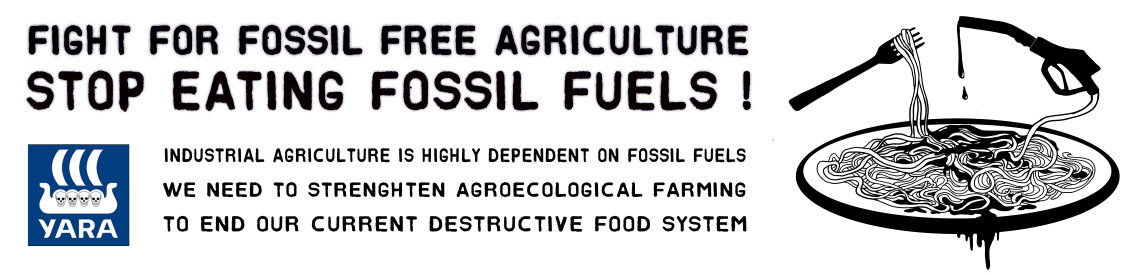
ImageThe current system of agriculture, based on mass import and export, is completely dependent on the consumption of fossil fuels. Chemical agriculture is responsible for a quarter to a third of the release of all the greenhouse gases. Over 80% of the cultivated GMOs are pesticide resistent, the remaining 20% produces insecticide inside the plant. This form of food production is extremely harmful to people, nature, and the climate. Genetical engineering will not contribute any solution to climate change.

Monsanto is part of the 'Round Table of Responsible Soy' (RTRS), a greenwash initiative to label RoundupReady GM soy as 'responsible'. The label will be launched in June 2010.

Genetic engineering is often presented as a solution to the global food question. But in spite of 15 years of cultivation of genetically manipulated crops, 2009 witnessed a record amount of starvation. GM crops have not increased yields. "The food problem requires completely different solutions. We need to drastically change course, away from large-scale chemical agriculture, towards local food production in harmony with nature, without pesticides and without genetically manipulated crops. A world without Monsanto is a good step in that direction," according to Miranda de Boer from 'Roundup Monsanto'.

notes:
[1] For further information about the development of patent law and breeders' rights, consult a press release from A SEED Europe about the subject: http://www.aseed.net/kwekersrecht-vs-patentrecht
[2] See the film 'The World According to Monsanto'

A series of fotos you can find at the picture report of the action.

More background information can be found at:
- http://www.gentech.nl
- http://www.gmwatch.org
- http://www.no-patents-on-seeds.org
- http://www.aseed.net/monsanto
- http://www.combat-monsanto.co.uk
- http://www.toxicsoy.org
Last Updated ( Sunday, 30 May 2010 )